BEST DUTCH GRADUATION PROJECTS IN ARCHITECTURE, URBANISM, INTERIOR- AND LANDSCAPE ARCHITECTURE

On Sunday, June 16, an independent jury consisting of Sereh Mandias, Jeroen van Mechelen, Aura Luz Melis, Wouter Pocornie, and Paul Roncken announced the winners of Archiprix 2024. The ceremony took place at the Nieuwe Instituut in Rotterdam.
From the jury report: The jury characterises the entries to Archiprix 2024 as a quest for the legitimacy of the design disciplines, a quest conducted noticeably often in the company of others, or within the context of other domains. The jury is enthusiastic about these multifocal endeavours as they encourage a greater and more varied authorship and ownership, where equality is key.
Four winners and three honourable mentions
Out of the 27 presented projects, four were chosen as winners, and three plans received honourable mentions.
The four first prizes go to (in alphabetical order):
1. Burnt: A Tale of Three Fires – Jacob Heydorn Gorski
Academie van Bouwkunst Amsterdam / Landscape architecture
The project aims to confine wildfires to specific pockets that protect larger areas, based on indigenous fire prevention methods from the Front Range mountains in Colorado. The plan focuses on restoring local ecology by integrating fire-resistant flora and fauna and enhancing the resilience of fire-affected communities. The plan addresses multiple dimensions of the field and showcases an interesting mix of evidence-based design.
2. DE WACHTKAMER – Tom Slots
Academie van Bouwkunst Arnhem (ArtEZ) / Architecture
This plan repurposes the unused Lelystad-Zuid station into a new type of urban farm with a dismantlable wooden structure contrasting with the existing concrete infrastructure. The design emphasises transience, slowness, and reuse, reactivating the neglected station area for social interaction, leveraging the emptiness of the place as its main quality. The jury appreciates the poetic and speculative nature of the plan, which redefines 'non-places’.
3. The Eyes Are the Windows to the Soul – Gavin Fraser
Academie van Bouwkunst Amsterdam / Architecture
This project explores the psychological and societal effects of visual impairments, viewing blindness not merely as a physiological issue. In a former warehouse in Greenock, Scotland, an eye clinic with a social program is proposed, where sensory architecture and carefully designed navigation systems ensure the psychological safety of visitors.
4. The Forest Formerly Known as… Parkstad – Lea Hartmeyer
TU Delft / Landscape architecture
This plan transforms the former mining area of Parkstad in South Limburg through a hybrid vision of city and landscape. The project introduces an extensive forest network to harmonise the relationship between humans and nature from a 'care' perspective, with concepts like responsibility, collectivity, and community spirit. The ambition is achieved by sketching a theoretical framework hitched to several concrete interventions that anchor the project in place.
The three honorable mentions go to:
1. Bloemkoolwijken: The New Vernacular? – Julia Ravensbergen
TU Delft / Architecture
This plan explores the use of regional biobased materials to retrofit poorly insulated homes in 1970s and 1980s housing enclaves known as ‘cauliflower neighbourhoods’ (bloemkoolwijken). By using locally grown raw materials for facade cladding, this hands-on project combines architecture and landscape in an accessible way. The designer successfully initiates a charm offensive and sparks debate on large-scale sustainability efforts for these neighbourhoods with a dated image from a renovation perspective.
2. Recollections – Structuren van momenten – Margot van Bekkum
Academie van Bouwkunst Rotterdam / Architecture
The principal actor in this project is a building on Rotterdam’s West-Kruiskade that has survived demolition and transformations has served as a pop music venue. The designer meticulously examines the over 100-year history and restores the complex as a monument of memory, emphasising temporal layers and phenomenology. The result is a poetic and layered narrative, where architectural elements are reintroduced as 'recollections’, bringing the building's history to life both visually and audibly.
3. Retreat the Line: Empowering Play as Another Way of Making Architecture – Jakub Biernacki
TU Delft / Architecture
This project advocates for an inclusive and community-oriented architectural practice, inspired by the concept of the 'commons’. In Burgess Park, South London, four red pavilions are introduced as playfields for social interaction, using local materials and craftsmen. The presentation stands out with a long overview drawing and images of the community process, focusing on social engagement and a call for systemic change.
Pilot ‘Open Work’
This year, Archiprix takes a step further in strengthening its position as a link between culture, education, and professional practice with the pilot 'Open Work’. The title 'Open Work' refers to Umberto Eco's book 'Opera Aperta’, in which he views concepts such as openness, indeterminacy, and ambiguity as a continuous revision of meanings and certainties. According to Eco, the (art)work is never finished and continuously allows successive interpretations.
For this edition, Archiprix invited several public organisations and other parties to share their commitment to the design questions raised in the winning plans and to endorse their social significance. Present at the award ceremony were:
- Séverine Kas, Accessibility expert | inclusive design advice at Stichting Accessibility
- Iris Meerts, Mayor of Wijk bij Duurstede
- Caroline Porsius, Program Director Green Metropolis at Staatsbosbeheer
- Miguel Loos, Senior Advisor at Bureau Spoorbouwmeester
- Eric Dil, Senior policy officer at the Heritage and Arts Directorate of the Ministry of Education, Culture and Science
- Erik Jutten, Stad in de Maak
- Jan Willem van de Groep, Gideon, founder program Building Balance
Download: the jury report (Dutch) or jury report (English).


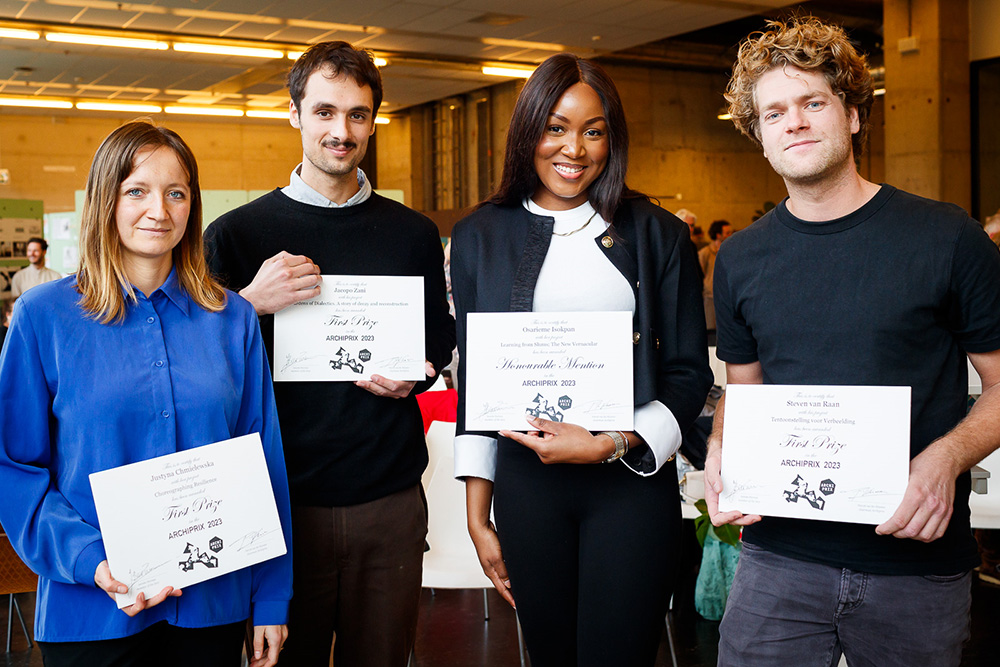
 all pictures by Fred Ernst
ARCHIPRIX
Museumpark 25
3015 CB Rotterdam
office@archiprix.nl
Archiprix presents the best graduation projects selected by the Dutch master courses in the fields of architecture, urban design, interior and/or landscape architecture. This graduation work presents a wealth of ideas for a broad range of contemporary and future challenges. Browse the collection of projects by subject or location in our projects database.